
 Žitný Ostrov monitoring
A strategic drinking-water reservoir
for Slovakia
Žitný Ostrov is among the most important drinking-water reservoirs in Central Europe and, for Slovakia, a strategic natural resource of extraordinary importance. It is a vast hydrogeological body formed by thick layers of gravel and sand, between which there is an enormous amount of groundwater. This water is continually replenished, above all by infiltration from the Danube, and under natural conditions it is filtered at the same time, which makes it an exceptionally good source of drinking water.
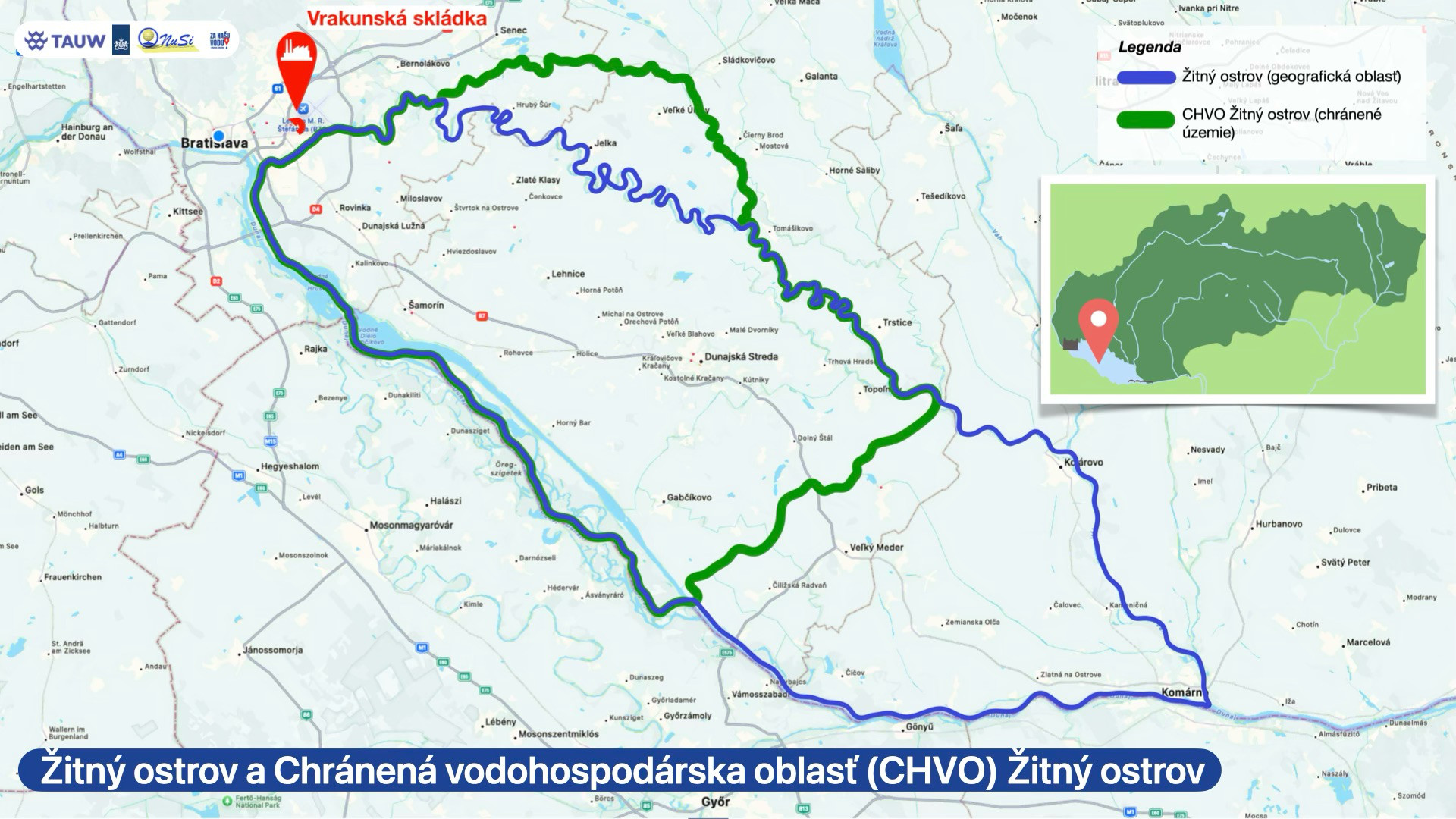
It is estimated that Žitný Ostrov holds about 15 billion cubic metres of groundwater, a volume that far exceeds Slovakia’s ordinary consumption. It is also a resource that is continually renewed. That is why Žitný Ostrov is spoken of not only as national wealth, but also as an area of European importance. That uniqueness, however, also means a great responsibility. If Slovakia wants to keep this water for future generations, it must protect it actively.
Water as wealth that can be
lost
Groundwater seems self-evident. We do not see it, we do not hear it, and in everyday life we often realise its value only when a problem arises. That is one of the main paradoxes of Žitný Ostrov. On the one hand it is an area with enormous water potential; on the other it is a place into which various forms of pollution have been entering for decades.
The greatest threat is not only the immediate loss of a single source, but the gradual, long-term degradation of groundwater, which can develop for years without the public being sufficiently aware of it. What enters the underground today can show itself in wells, in water sources and in the quality of the environment only many years later.
Bratislava as a source of pollution
heading for Žitný Ostrov
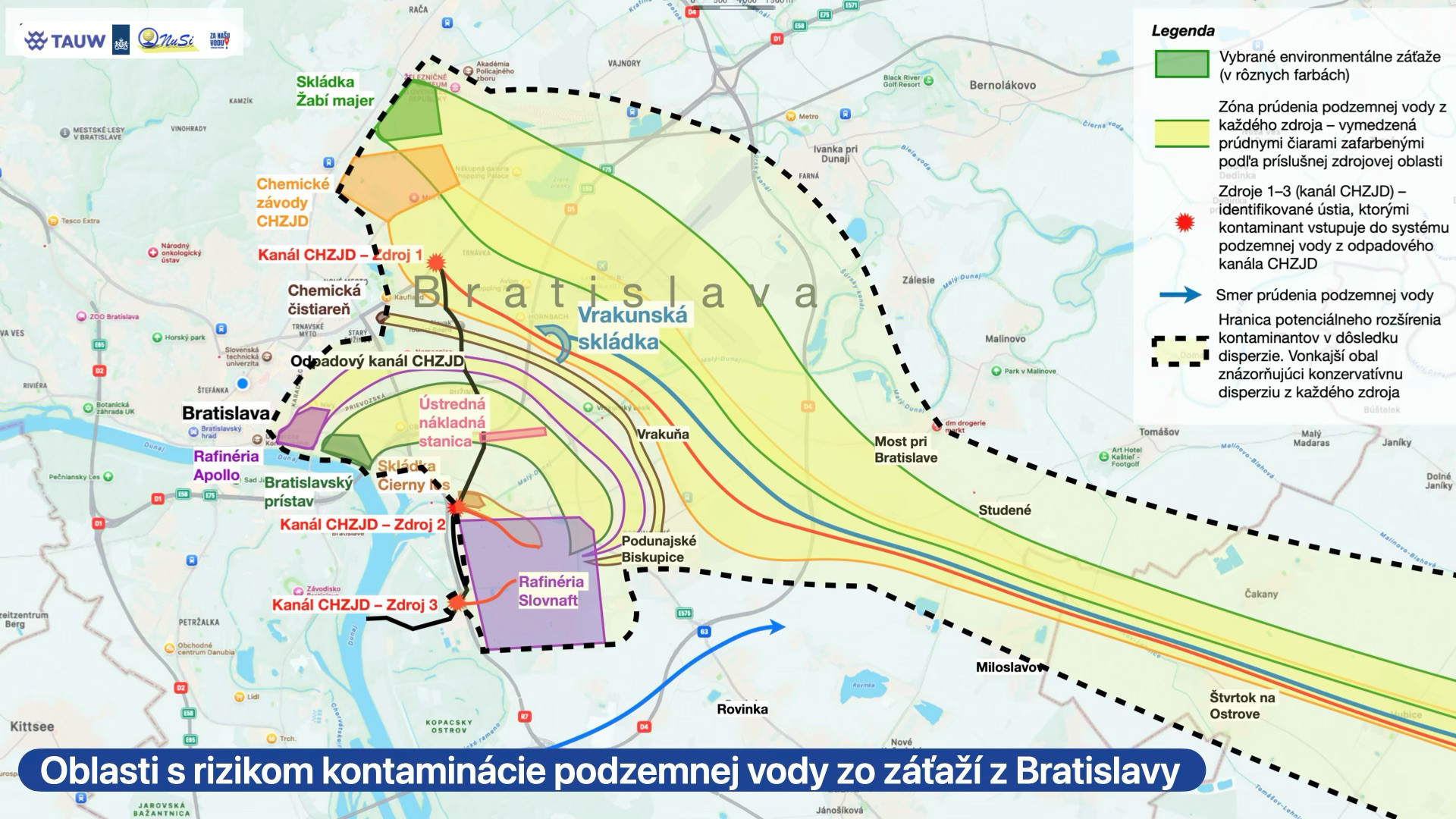
One of the key subjects in protecting Žitný Ostrov is the pollution that comes from Bratislava. Groundwater in this area does not flow at random. It has its hydrogeological rules, and part of the water from Bratislava heads precisely into the space of Žitný Ostrov. The problem is that Bratislava contains a large number of old environmental burdens, which arose above all in the period of intensive industrial development.
They include former chemical plants, old industrial sites, landfills and other contaminated localities. Part of these burdens is linked to the production of pesticides, herbicides, oil substances, chlorinated hydrocarbons and other hazardous chemical compounds. Because these substances entered the soil and the underground layers, their effect did not end when production stopped. Pollution can keep spreading underground for decades.
The Vrakunská landfill as the best-known
example
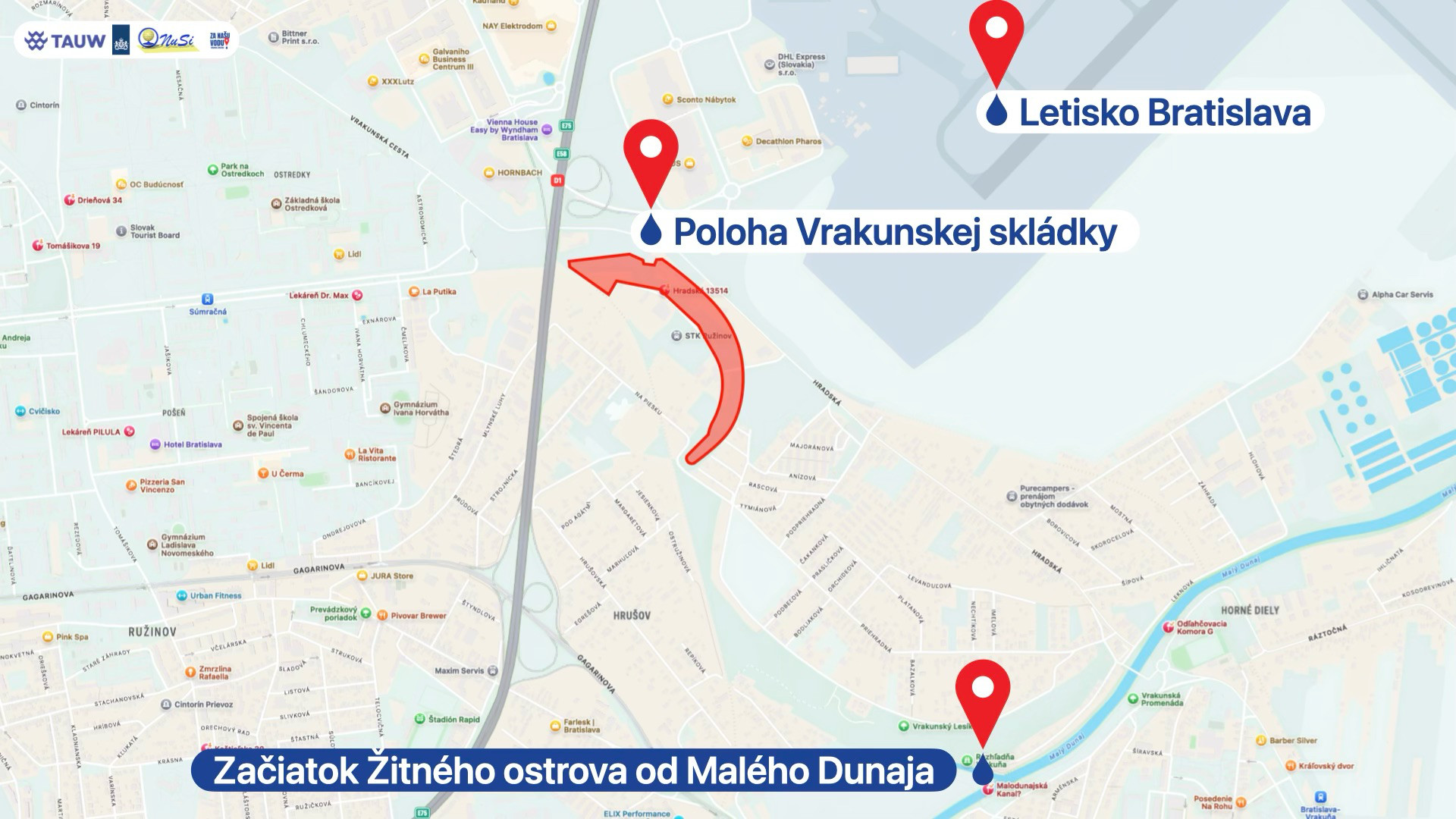
The best-known and most discussed case is the Vrakunská landfill. Between 1966 and 1979, tens of thousands of cubic metres of toxic waste were deposited at this site, mainly from the former Juraj Dimitrov chemical works, later Istrochem. Very varied chemical waste reached the landfill, from pesticides and herbicides to other hazardous substances produced by chemical manufacture.
The fundamental problem is that the landfill was not built as an isolated, safe repository. The waste was placed in an environment that did not have a reliably sealed base, so water could flow through the landfill and gradually wash contaminants from it into the underground. The drums of waste also corroded over time, their contents were released, and the pollution began to spread further. Layers of soil were later brought in over the landfill, but that did not solve the problem. On the contrary, the pollution moved to a less visible but much more dangerous level: into the groundwater.
The contamination plume: an invisible
threat underground
A so-called contamination plume was released from the Vrakunská landfill into the groundwater, a zone of pollution that spreads with the flow of the groundwater. It is an invisible but very concrete phenomenon. Some substances move faster, others more slowly, because they react with the environment, bind to rock particles, or are repeatedly released and captured. Even so, the movement of the pollution is long-term, continuous and headed into a sensitive area.

According to estimates, water can flow through the contaminated environment at a rate of hundreds of metres a year, and although the pollution itself moves more slowly than the water, it is still a significant shift. What matters is not only how far the contamination advances in one year, but above all that this process goes on all the time. Every further year means further litres and cubic metres of degraded water.
It is estimated that about 450,000 cubic metres of water can flow through the landfill area each year and become heavily contaminated. If the subsequent dilution and the effect on drinking-water quality are taken into account, the impact can amount to several million cubic metres of degraded water a year. That is an extraordinarily alarming figure, because this is not a one-off leak but a long-term process.
The Vrakunská landfill is not the only
problem
Although the Vrakunská landfill is often regarded as the greatest problem, it is not in fact the only source of pollution. Bratislava has several old environmental burdens, and together they create a wide, area-wide pressure on the groundwater heading for Žitný Ostrov. The sites of the former Istrochem, Žabí majer, old industrial localities around the Danube and other historical burdens are mentioned, for example.
What they have in common is that they contain similar groups of contaminants. When these substances enter the underground, they can mix with one another and create a complicated picture of pollution, in which it becomes harder and harder to tell precisely which part of the contamination comes from which source. That is why good monitoring and modelling matter all the more. Without them, underground pollution remains a problem that is hard to grasp: it cannot be ignored, but it cannot be managed precisely either.
Why a model of how the contamination spreads
is so important
If society wants to protect groundwater, it is not enough to know that a problem exists. It also has to know where the pollution is, which way it is moving, how fast it is spreading and which areas it may threaten in the future. A numerical model of groundwater flow and of contaminant transport serves exactly that purpose.
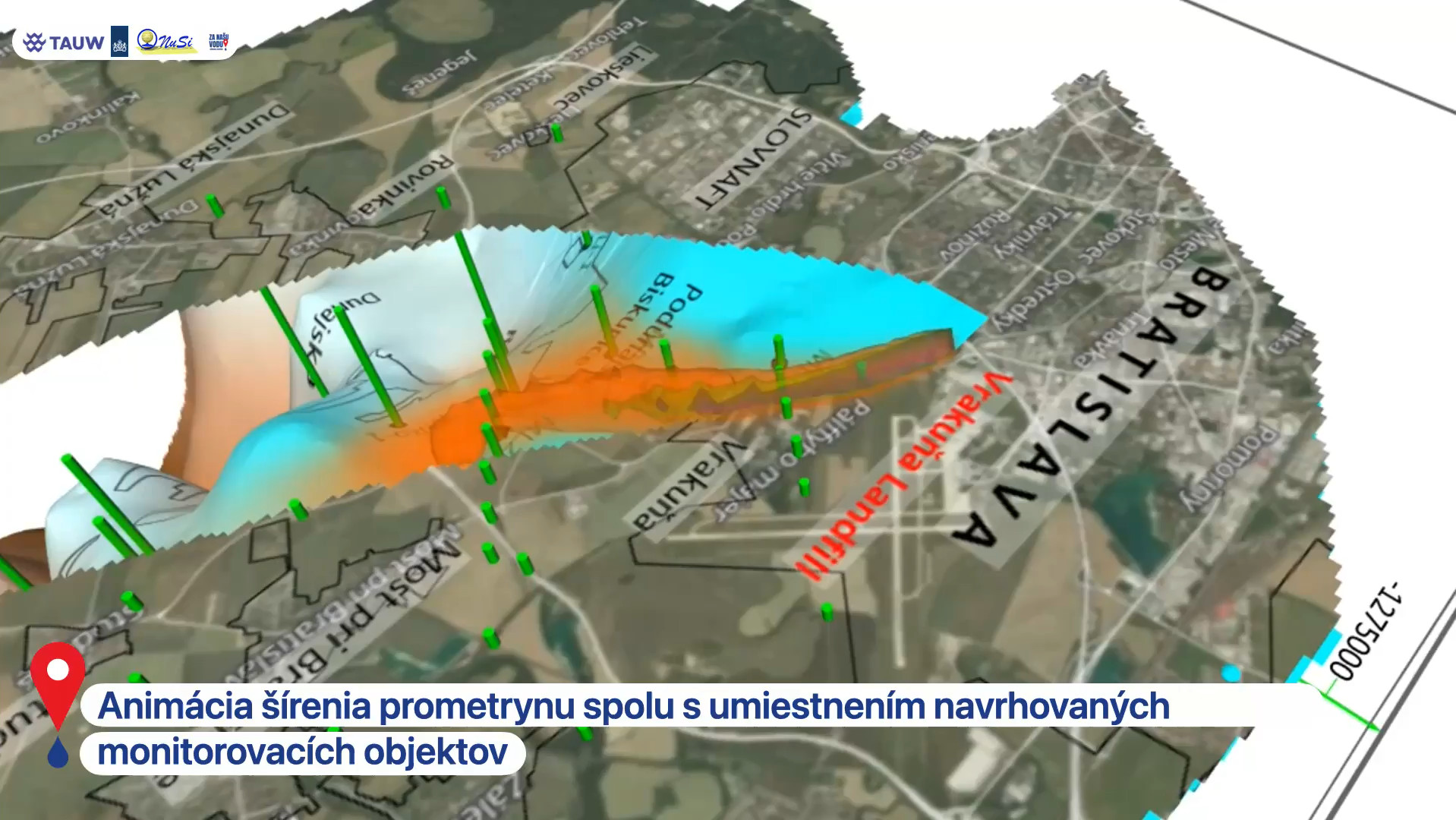
Such a model is a tool that can process the available data on geology, water flow, sample results and the properties of the contaminants, and turn them into a prediction of future development. The model therefore does not only say what is happening today; it helps estimate what may happen tomorrow, in five years or in ten years. It also makes it possible to test different scenarios — barriers, capture measures or pumping systems, for example — and to check what effect they might have.
A model never works on its own, however. It needs to be continually supplied with new data from the field. That is why it is inseparably linked to monitoring. Monitoring supplies data to the model, and the model in turn helps to propose where monitoring needs to be more precise. It is therefore a mutually connected process.
Monitoring as the basis of protection
Groundwater is invisible, and without boreholes nothing reliable can be found out about it. Monitoring is therefore a basic tool of protection. It means building monitoring boreholes, taking samples regularly and evaluating the results. Only then can it be revealed where the contamination already is, where it is heading, and whether it is approaching villages or water sources.
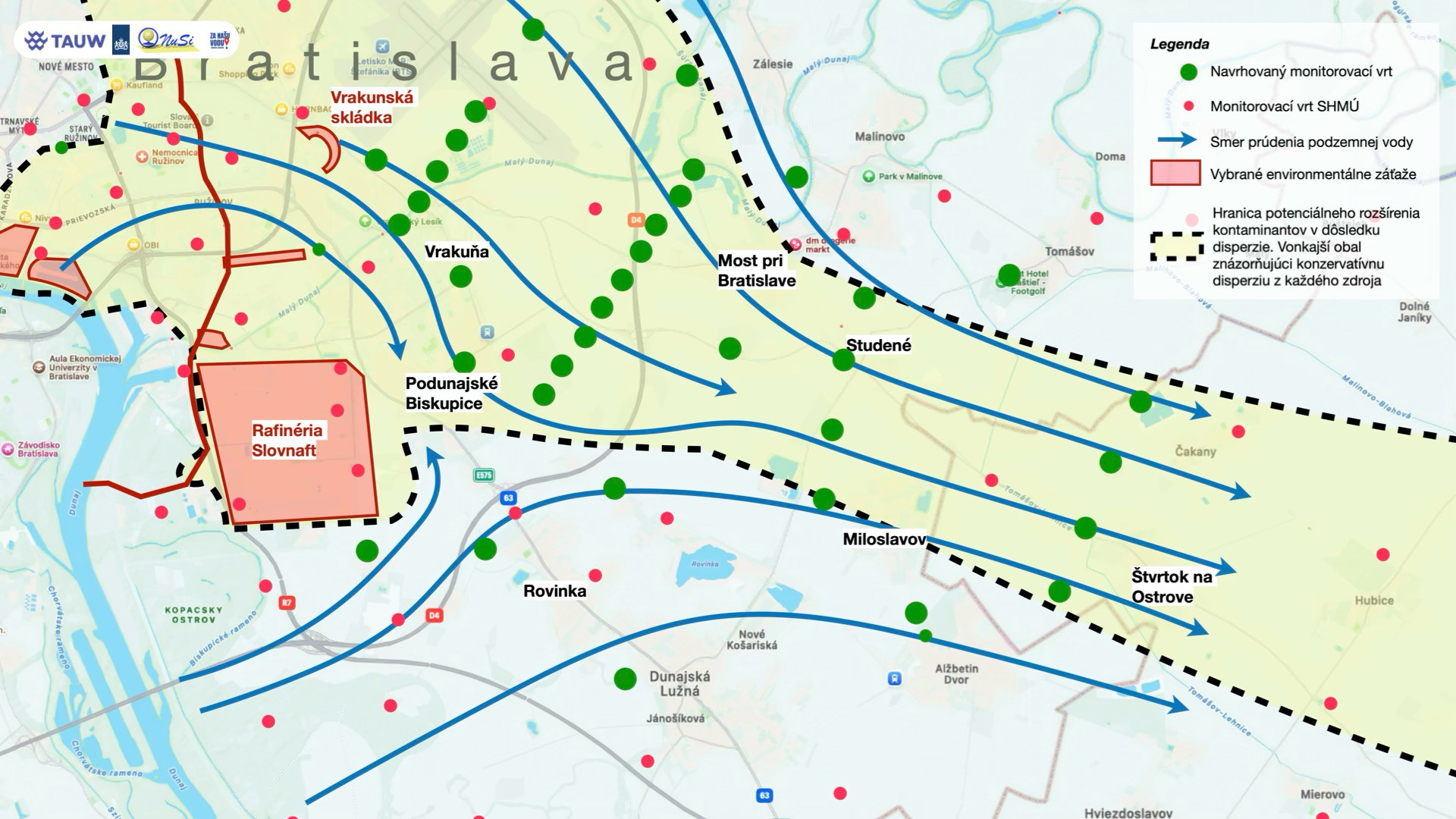
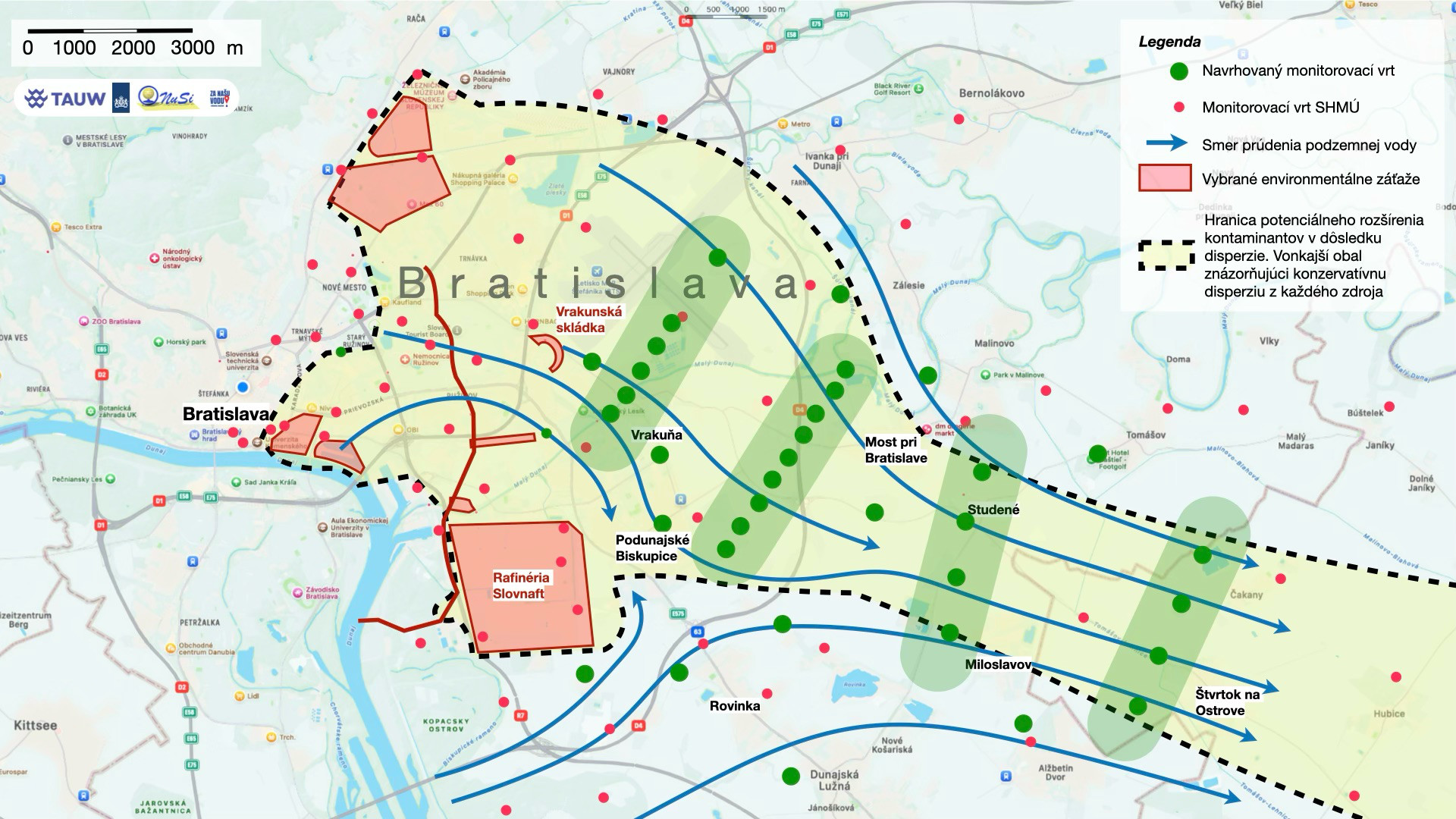
The proposed system counts on creating a network of about 35 monitoring sites, which would work at several depth levels and provide regular sampling several times a year. The number is not chosen at random. Both the number and the position of the boreholes come from modelling and from the effort to capture the main flows of contamination between Bratislava and Žitný Ostrov, while also creating warning points in front of the villages most at risk.
Such a system would not be a definitive solution to the whole problem, but it would be a first essential step towards early warning and the protection of residents. Its importance would be enormous precisely because, in many places today, a protective network of this kind simply does not exist.
Which areas are most at risk
According to the model so far, the belt along which pollution from Bratislava continues into the space of Žitný Ostrov is among the highest-risk areas. The areas in the direction of Vrakuňa, Podunajské Biskupice and further towards villages such as Most pri Bratislave, Studené, Štvrtok na Ostrove and Miloslavov are mentioned in particular. This is not a statement that all of these villages already have contaminated drinking water. It is a naming of the direction of flow and an identification of the areas that may be most at risk in the future.
It is important to realise that, with groundwater, the simple picture of a directly visible threat does not apply. Contamination can advance slowly but steadily. It is therefore essential to catch it before it shows itself in particular wells or in the water sources that residents use.
State processes are not enough yet
One of the strongest messages of this subject is a criticism of how state processes are set up today. Although there are declarations about protecting water, in practice a sufficiently functional, comprehensive and long-term sustainable system has not yet been created that would make it possible to protect the groundwater of Žitný Ostrov truly effectively.
The problem is not only in the technology, but also in the bureaucracy. Directives are formally fulfilled and documents are produced, but the result is not always the real protection of groundwater and of residents’ health. That also shows in situations where contamination was discovered only at the moment it had already arrived at a particular locality. Such an approach is late, and from the point of view of prevention it is insufficient.
Can monitoring serve as an early
warning?
This is exactly where the proposed system has its greatest importance. Its aim is not only to describe the existing state, but to create an early-warning system for villages and their residents. If the pollution is caught before it reaches wells or homes, there is room to react. Villages, local authorities and state institutions then gain time to decide and to prepare protective measures.
Such a solution is especially important for villages that are not yet connected to a large public water supply and where residents use their own wells. The risk is greatest there, because residents can depend directly on the quality of the groundwater where they live.
What such a system would cost
Compared with the value of the water it would protect, this is a relatively proportionate investment. Estimates say that building the proposed monitoring system could come to about one million euros, while operating costs for sampling and groundwater analyses also have to be counted. On the positive side, some boreholes that already exist could be used, which could lower the overall cost.
In the context of the value of the area being protected, of residents’ health and of the strategic importance of drinking water, this is an investment with a very favourable ratio of cost to benefit. It would be far more expensive to deal with the consequences once the contamination has fully shown itself.
What residents and local authorities
can do now
Until a comprehensive monitoring system exists, residents of villages that depend on their own wells should take care to have the water tested regularly. A basic analysis aimed at ordinary parameters and microbiology is not enough. In areas threatened by industrial pollution, tests for specific contaminants also have to be considered, such as pesticides, herbicides, chlorinated compounds and other chemical substances from industry.
Such testing is more expensive, but with drinking water it is a question of health and safety. Residents also need to raise this subject actively in their communication with their local authorities and to demand concrete solutions. The key message of the whole discussion is that the state will not solve the problem on its own if there is not sufficient public pressure.
Water is not a commodity, but a condition
of life
What matters is to realise that drinking water is not an ordinary commodity. It is a basic condition of life and a public good, for which society bears a shared responsibility. Žitný Ostrov is a unique gift of nature, but its value will be preserved only if it can be protected systematically.
That means three basic things. First, it has to be recognised that the water of Žitný Ostrov is a strategic wealth of Slovakia. Second, citizens and local authorities must take an active interest in the problem and not leave it only to formal state procedures. And third, if specialist capacity, public pressure and political will can be joined, there is still a chance to take the first necessary steps that will prevent the situation from worsening further.
Žitný Ostrov is an example of how an invisible problem underground can decide the future of a whole country. If we want to protect the water, we have to act before we start to lose it for good.